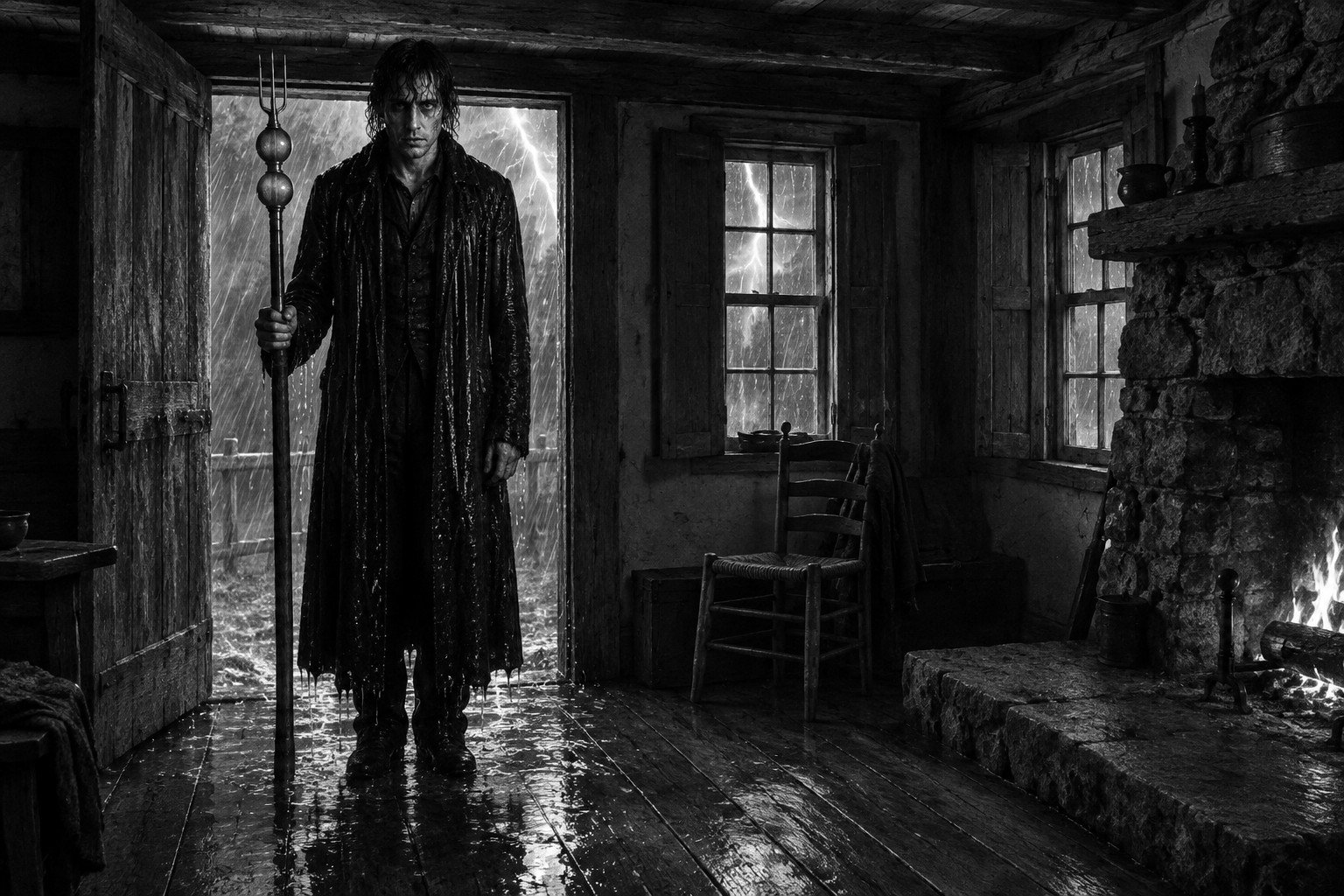
The Lightning-Rod Man — full text
Complete and unaltered, as performed. Read along, or read it after.
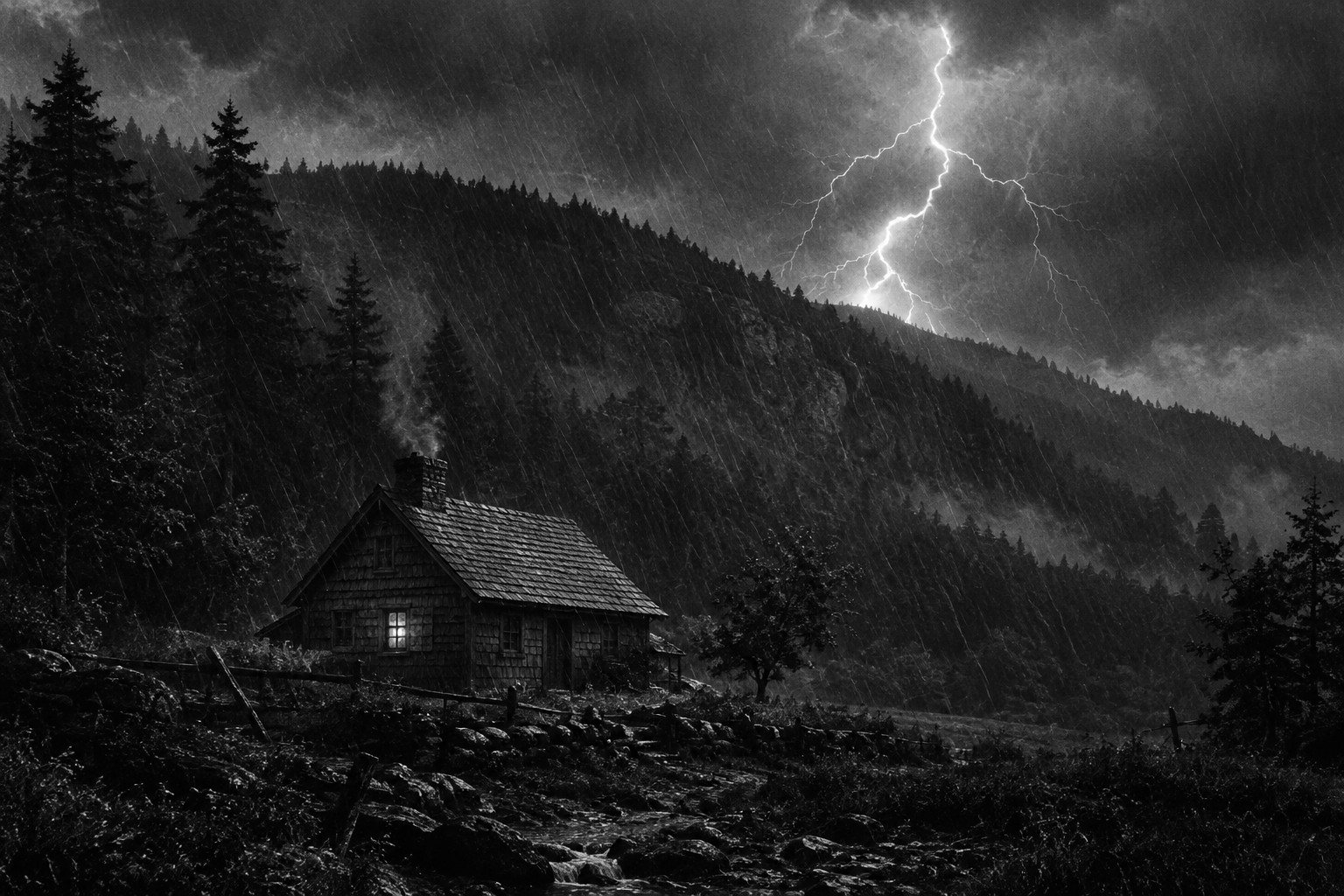
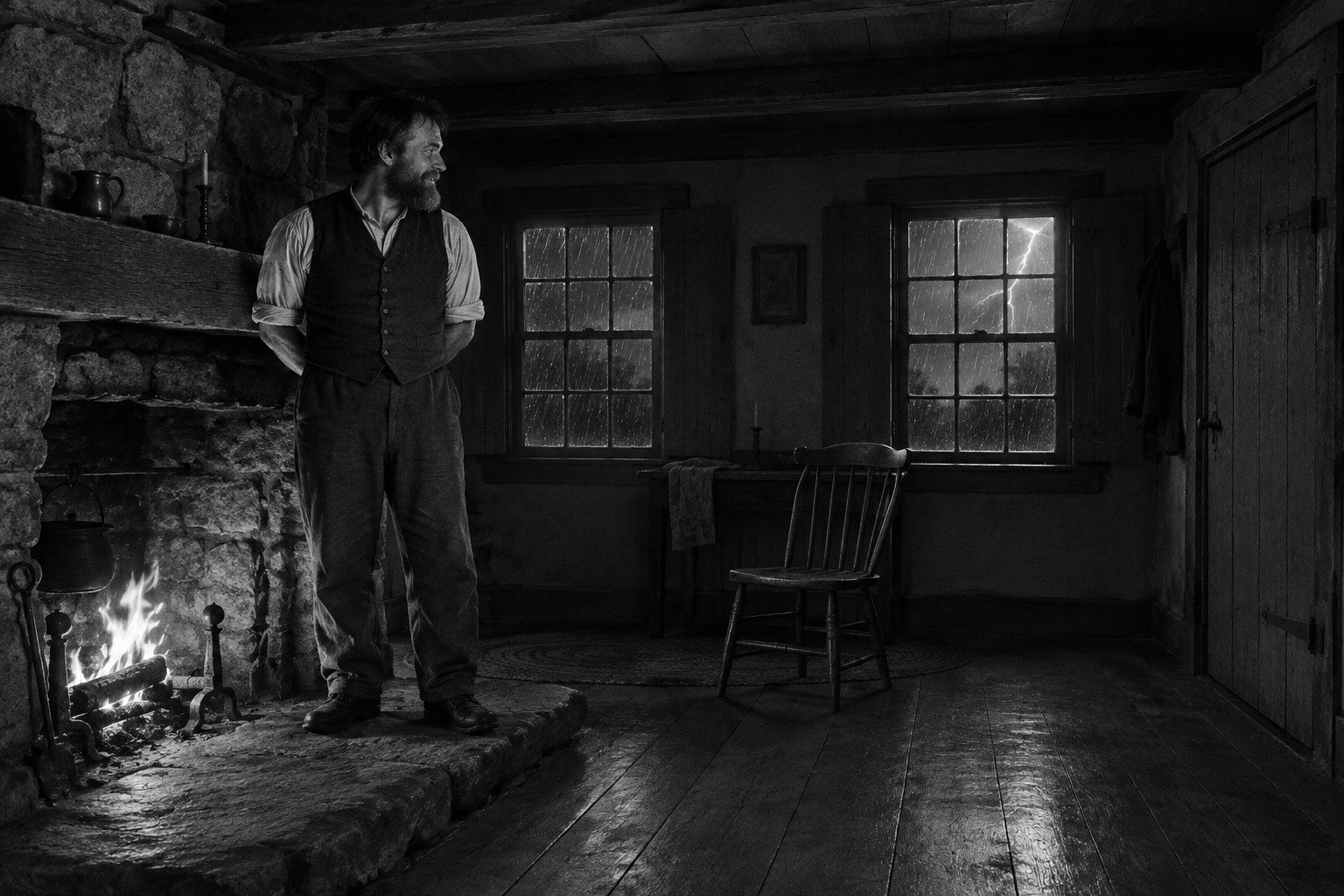
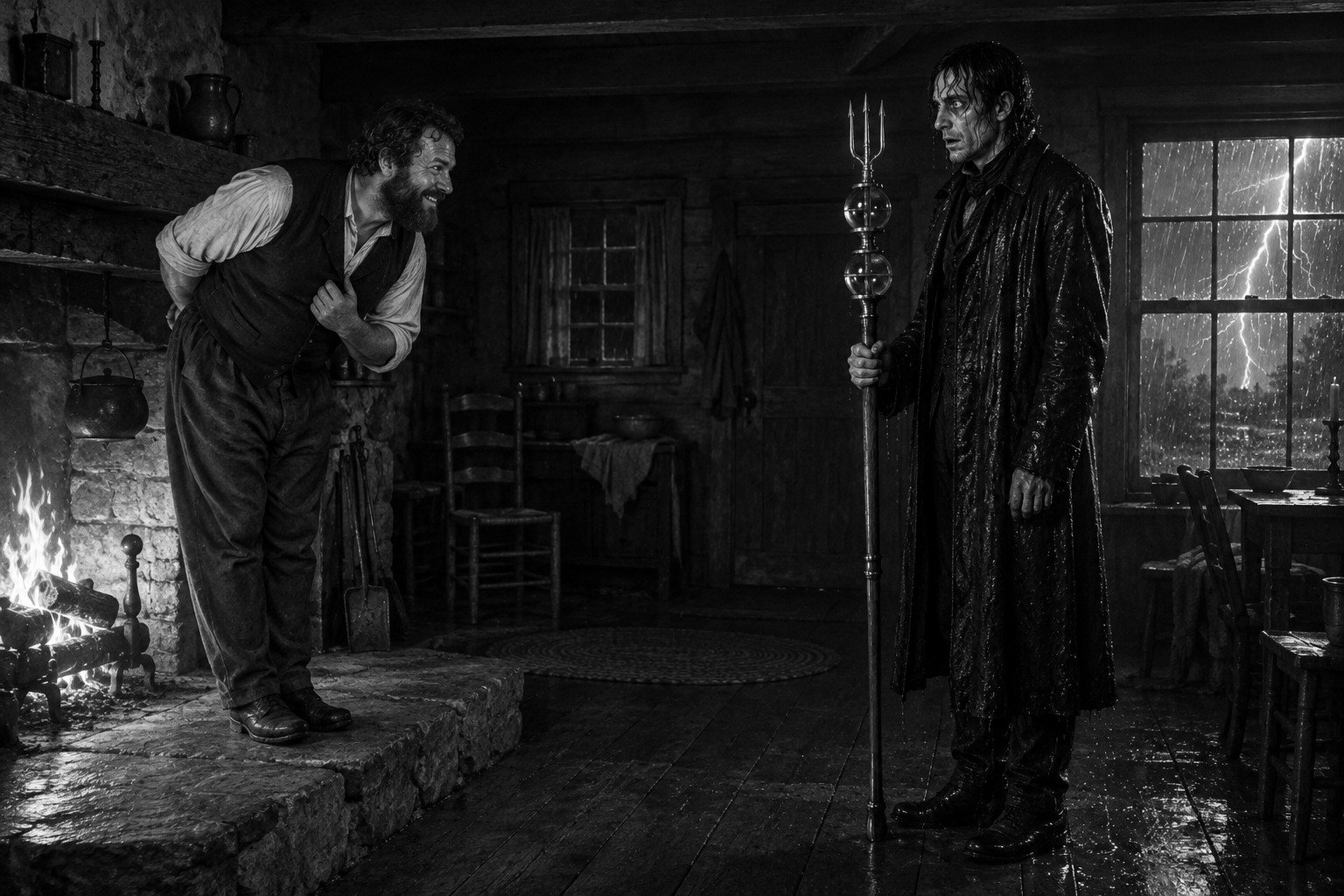
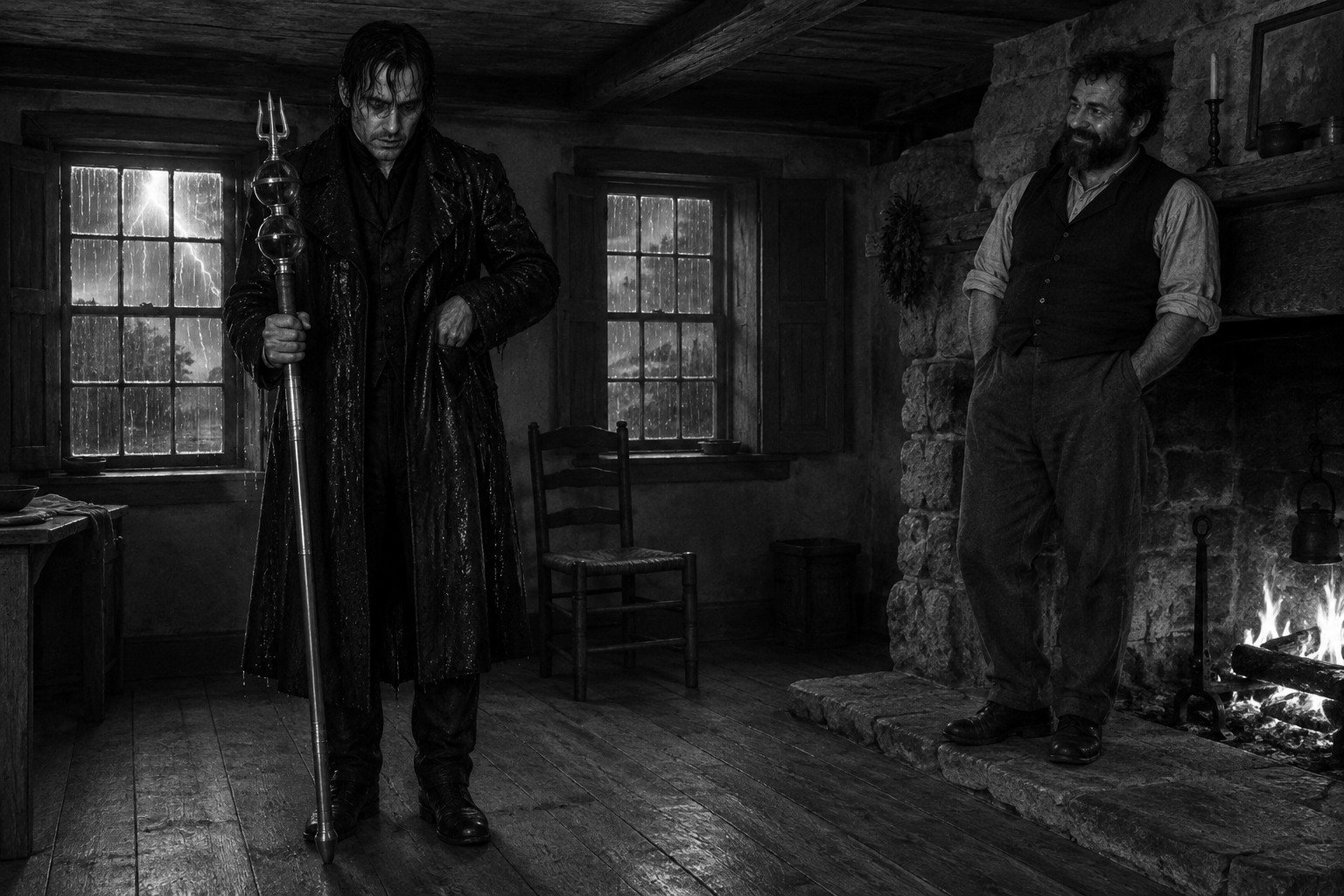
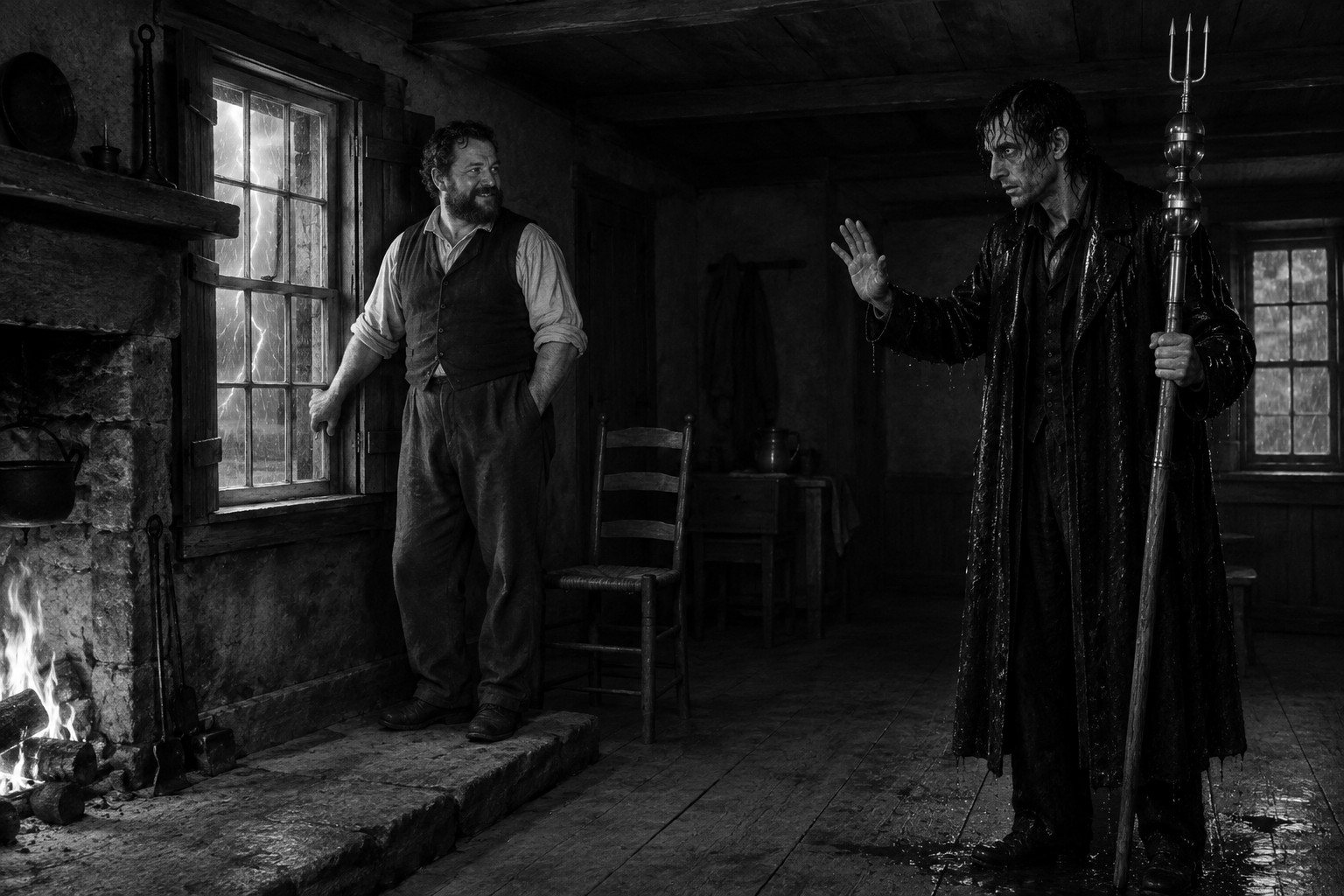
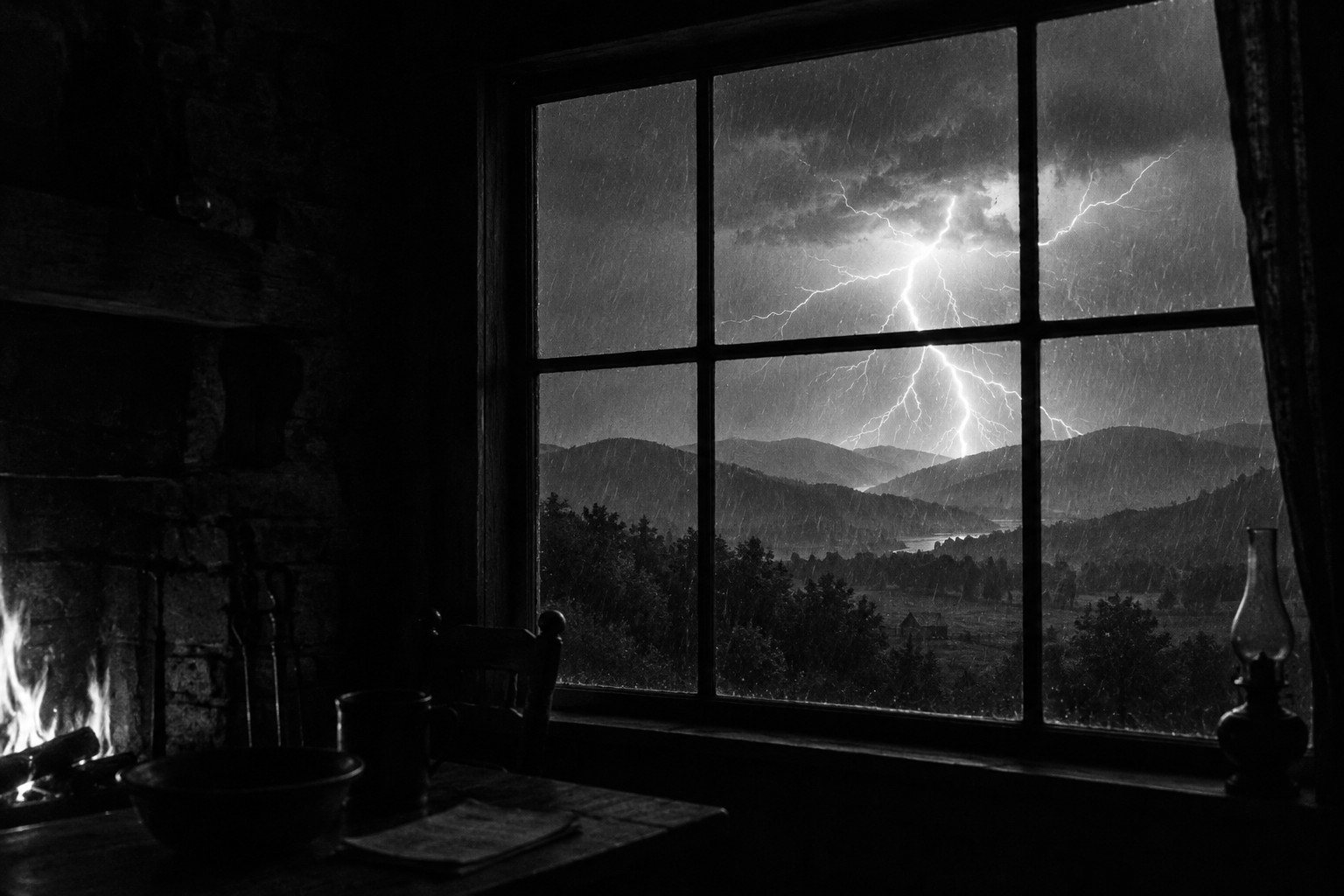
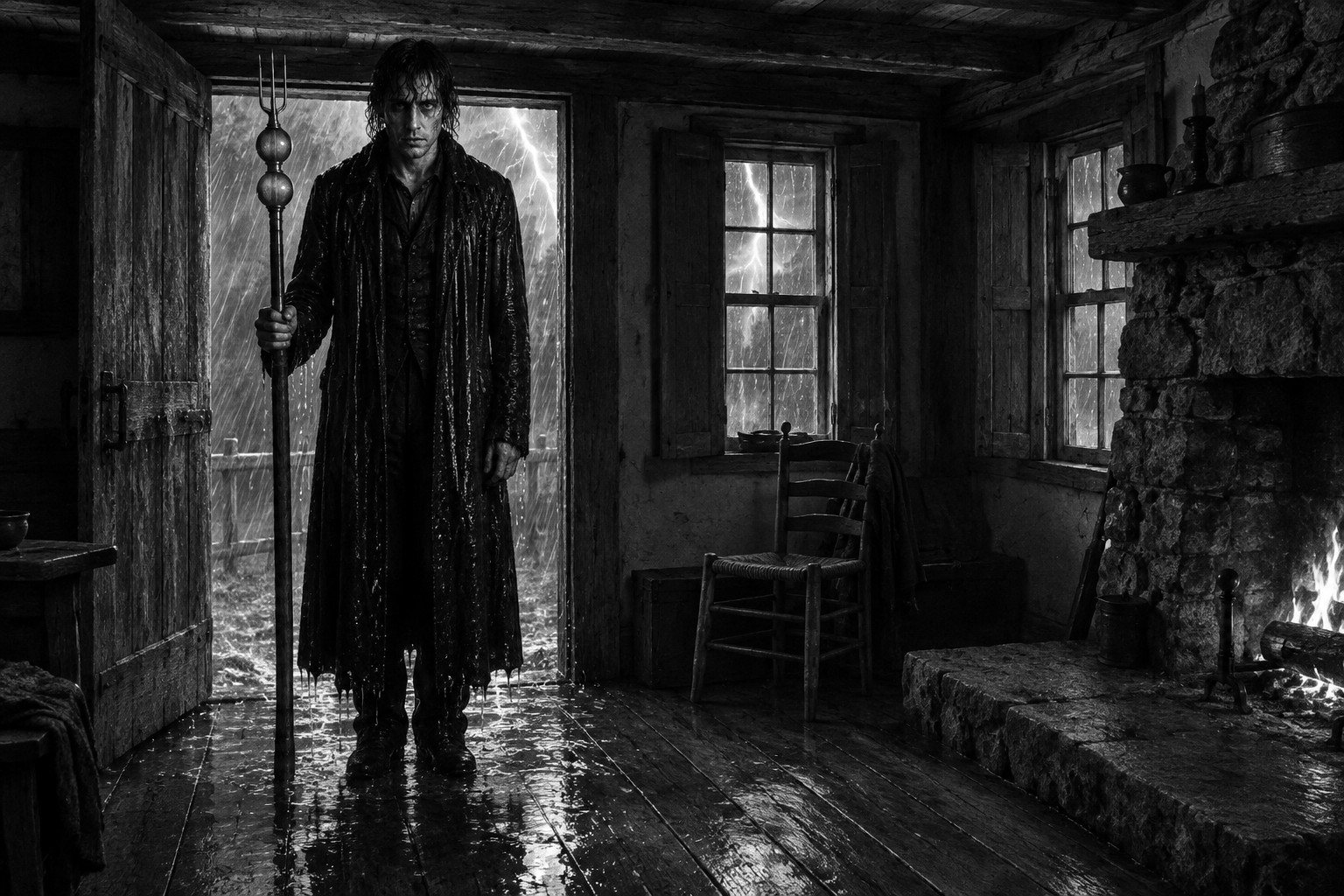
What grand irregular thunder, thought I, standing on my hearth-stone among the Acroceraunian hills, as the scattered bolts boomed overhead, and crashed down among the valleys, every bolt followed by zigzag irradiations, and swift slants of sharp rain, which audibly rang, like a charge of spear-points, on my low shingled roof. I suppose, though, that the mountains hereabouts break and churn up the thunder, so that it is far more glorious here than on the plain. Hark!—someone at the door. Who is this that chooses a time of thunder for making calls? And why don’t he, man-fashion, use the knocker, instead of making that doleful undertaker’s clatter with his fist against the hollow panel? But let him in. Ah, here he comes. “Good day, sir:” an entire stranger. “Pray be seated.” What is that strange-looking walking-stick he carries: “A fine thunder-storm, sir.”
“Fine?—Awful!”
“You are wet. Stand here on the hearth before the fire.”
“Not for worlds!”
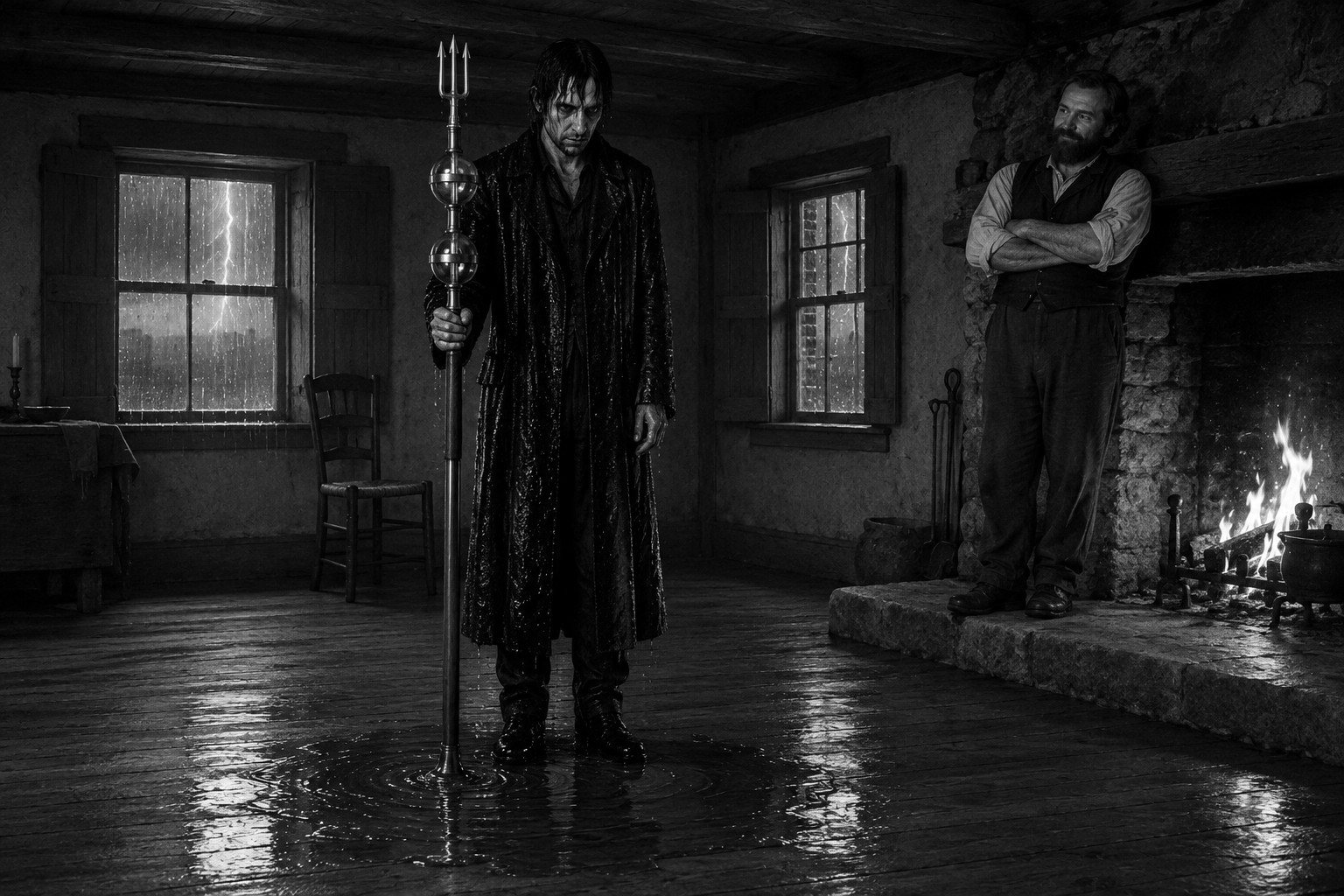
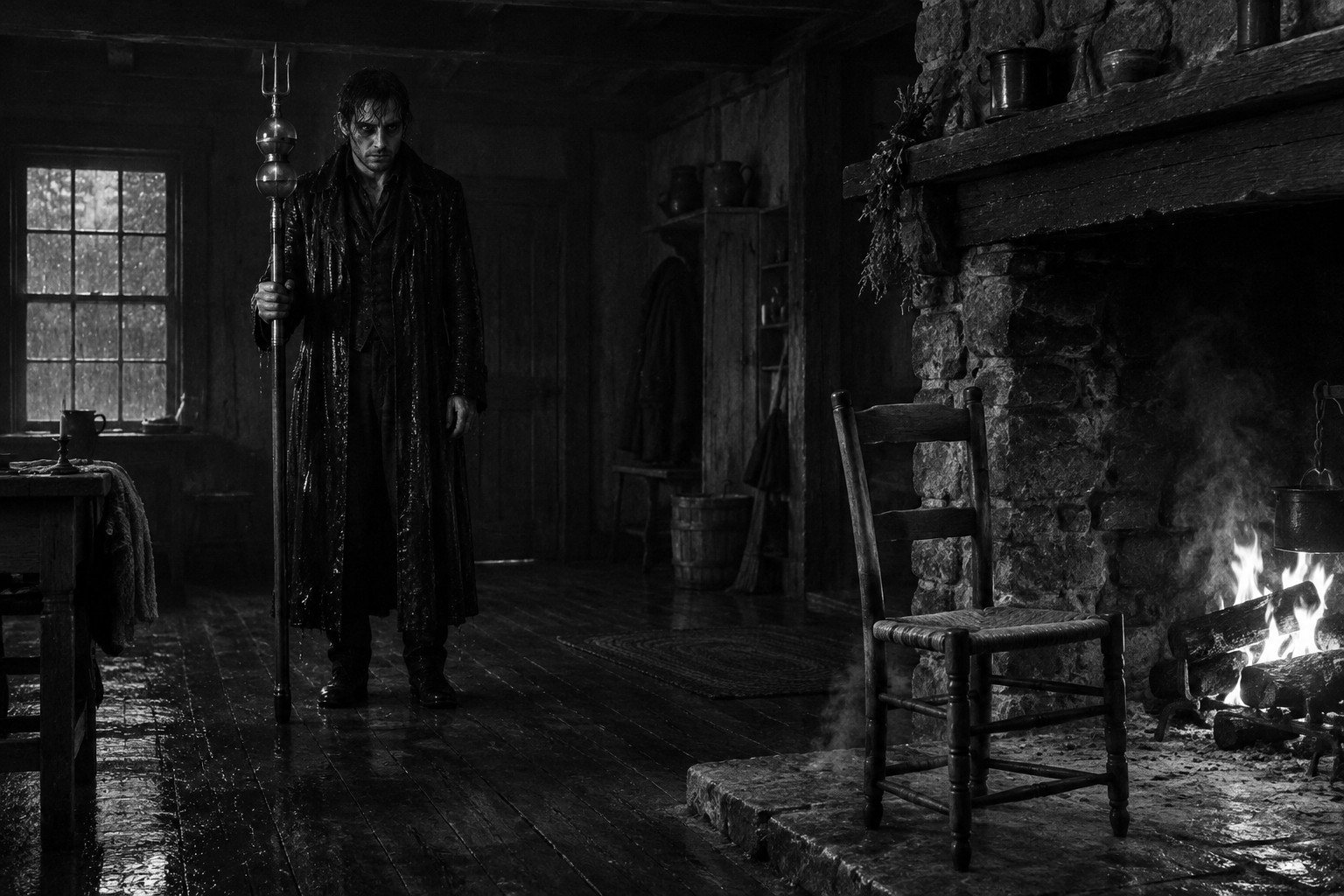
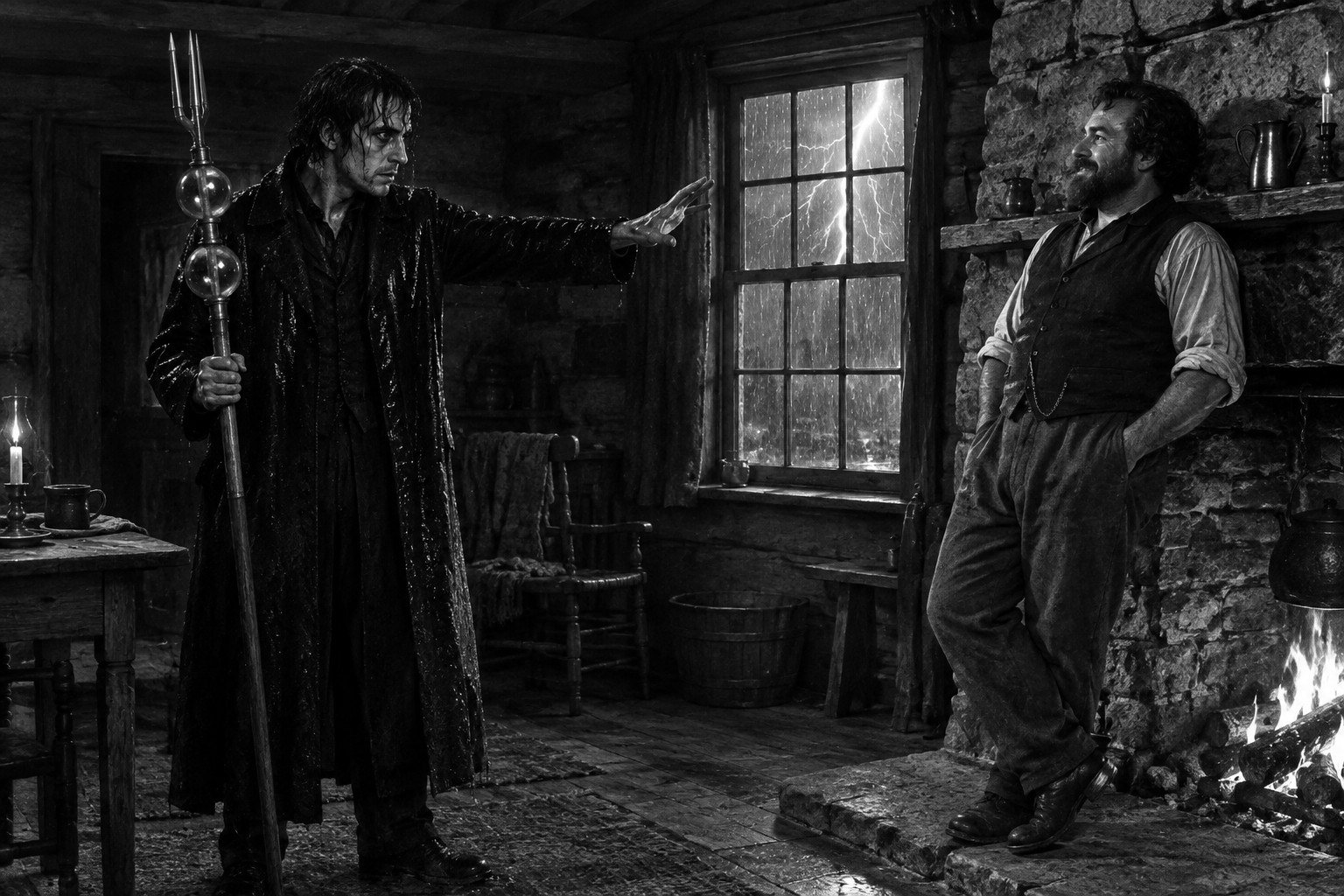
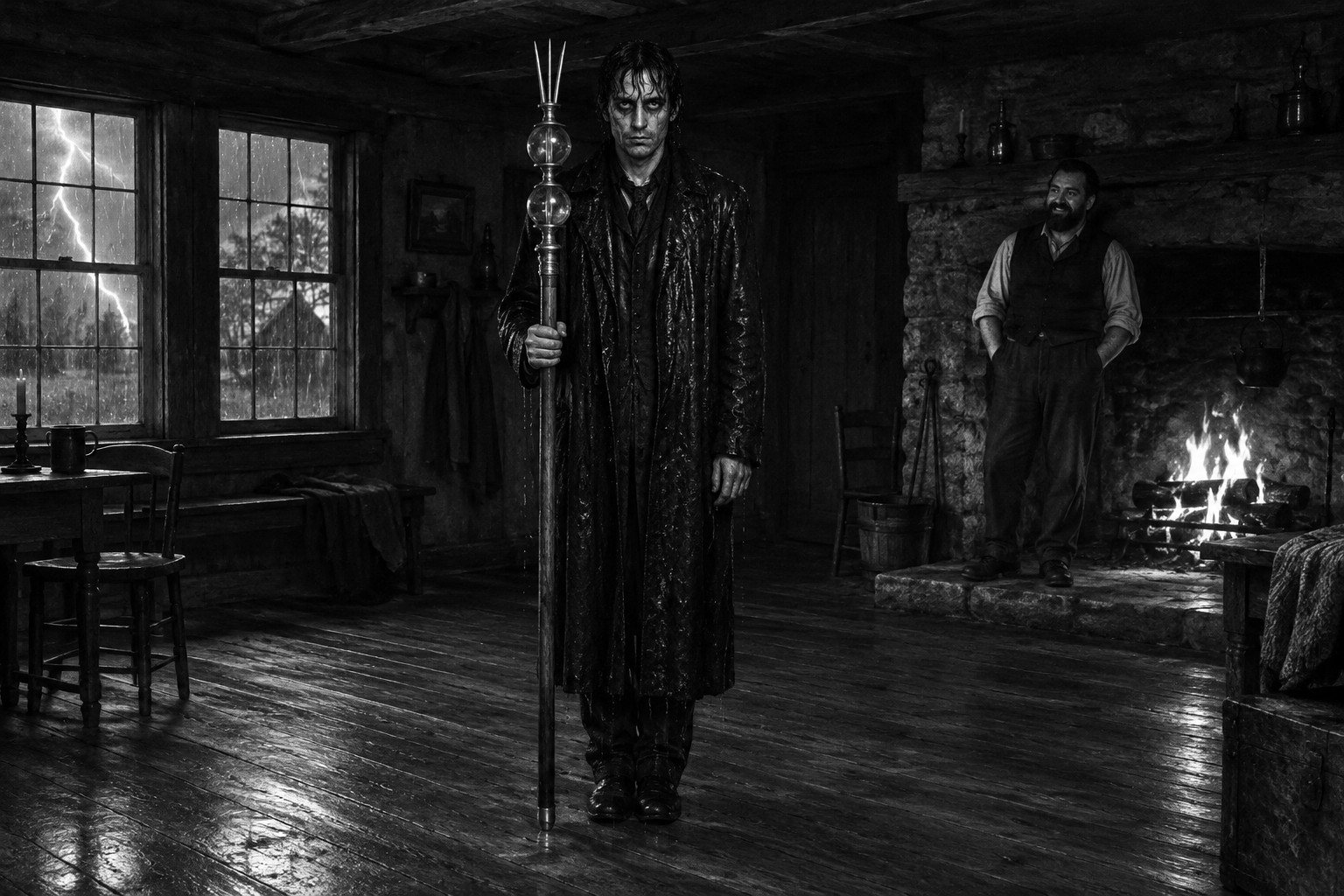
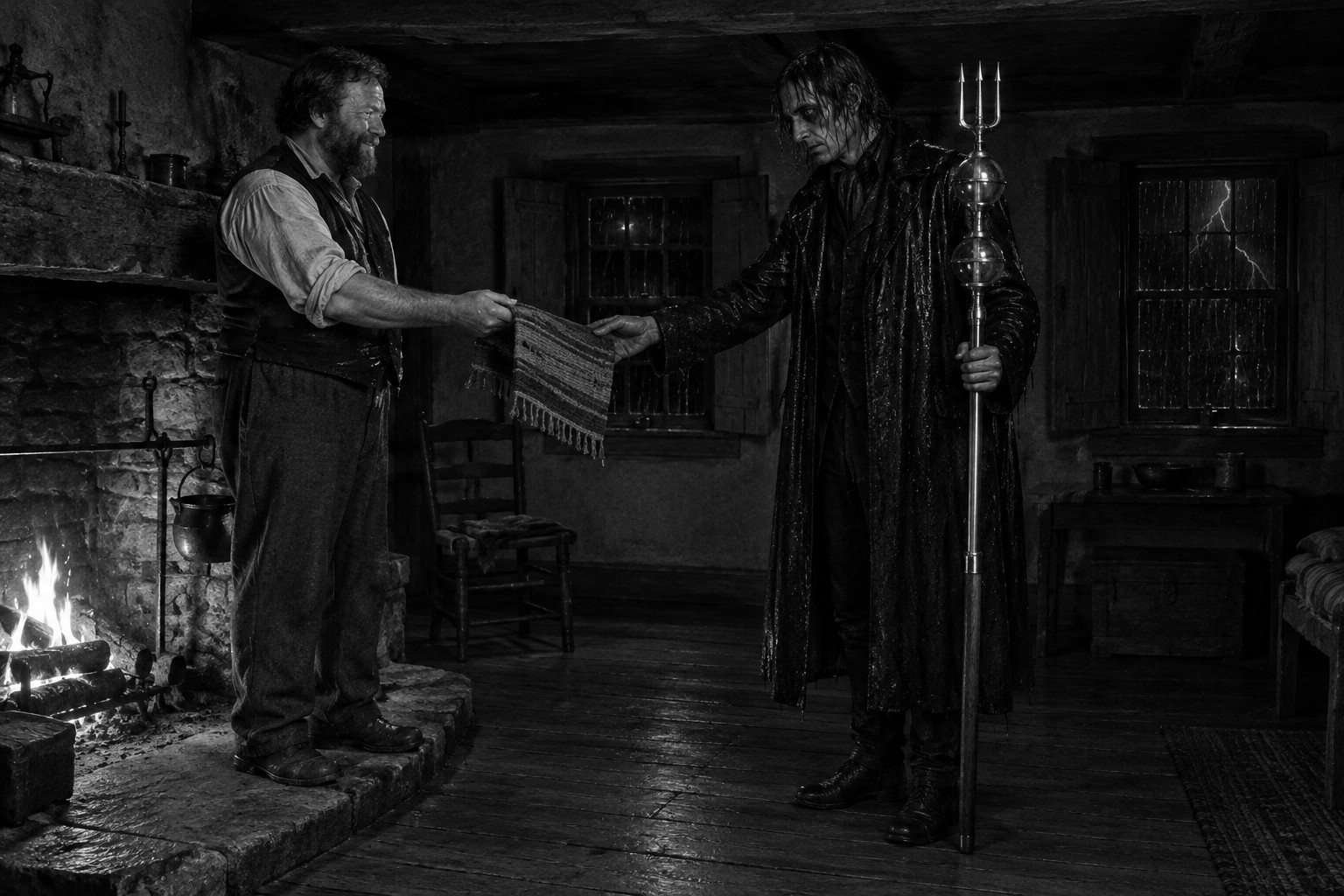
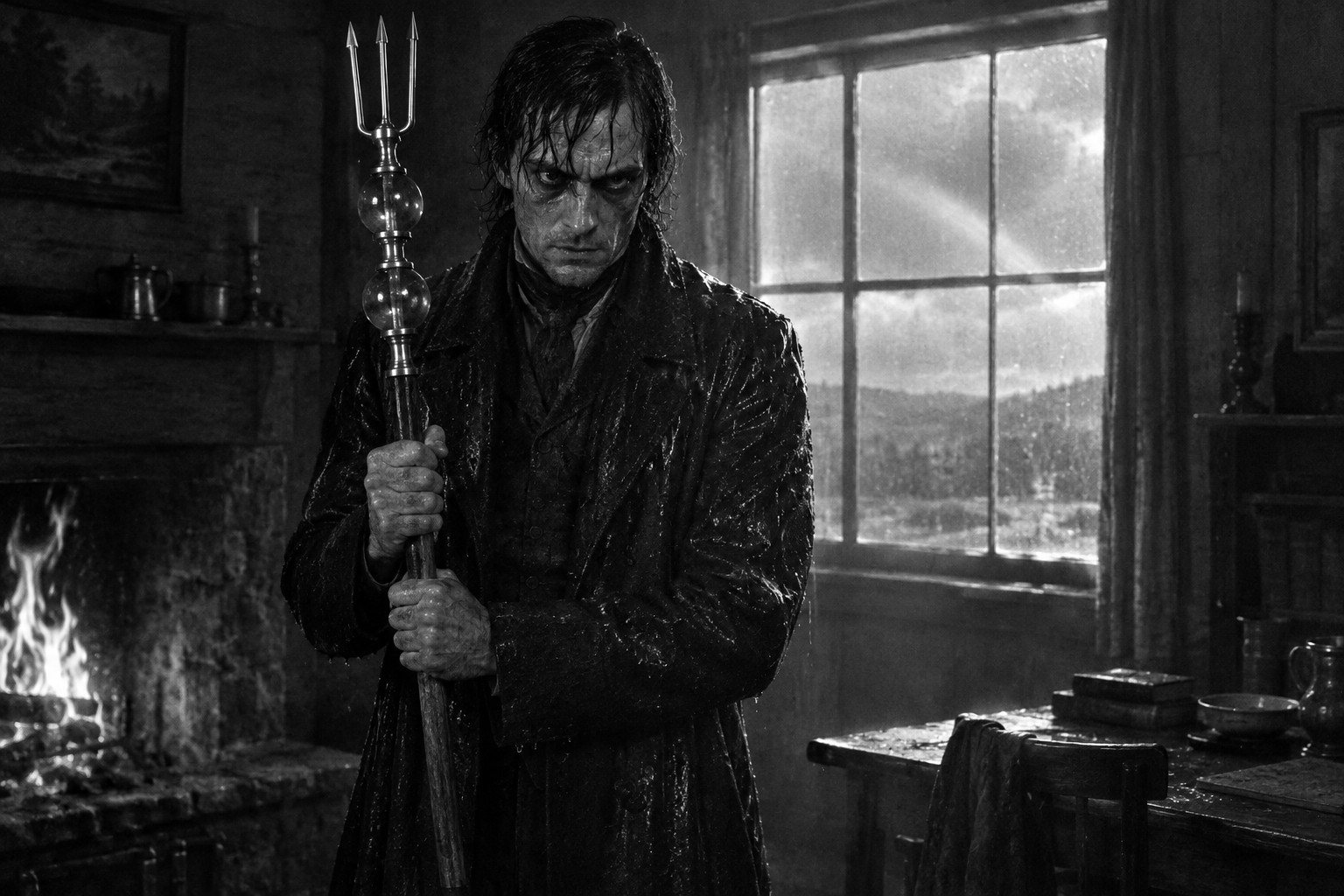
The stranger still stood in the exact middle of the cottage, where he had first planted himself. His singularity impelled a closer scrutiny. A lean, gloomy figure. Hair dark and lank, mattedly streaked over his brow. His sunken pitfalls of eyes were ringed by indigo halos, and played with an innocuous sort of lightning: the gleam without the bolt. The whole man was dripping. He stood in a puddle on the bare oak floor: his strange walking-stick vertically resting at his side.
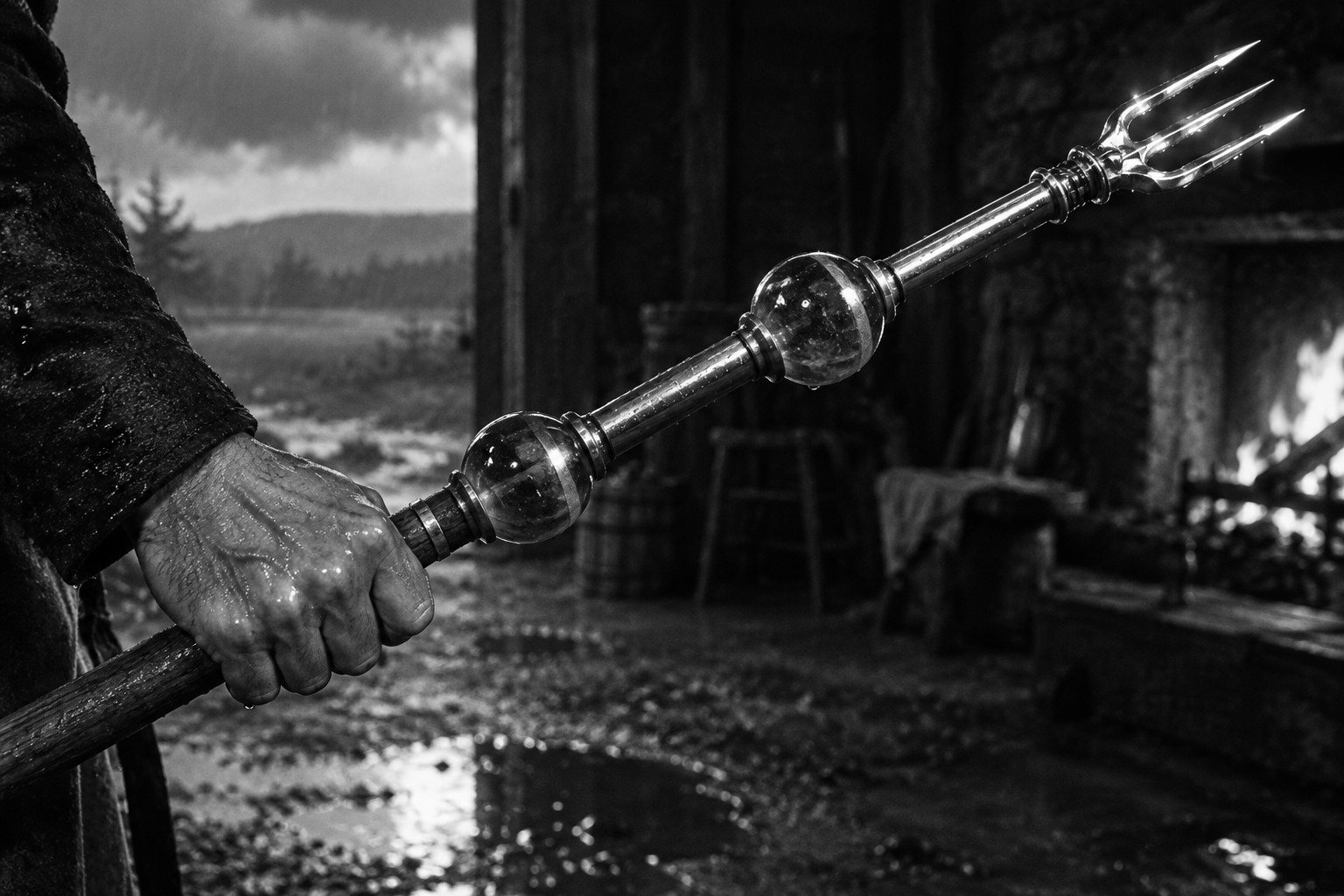
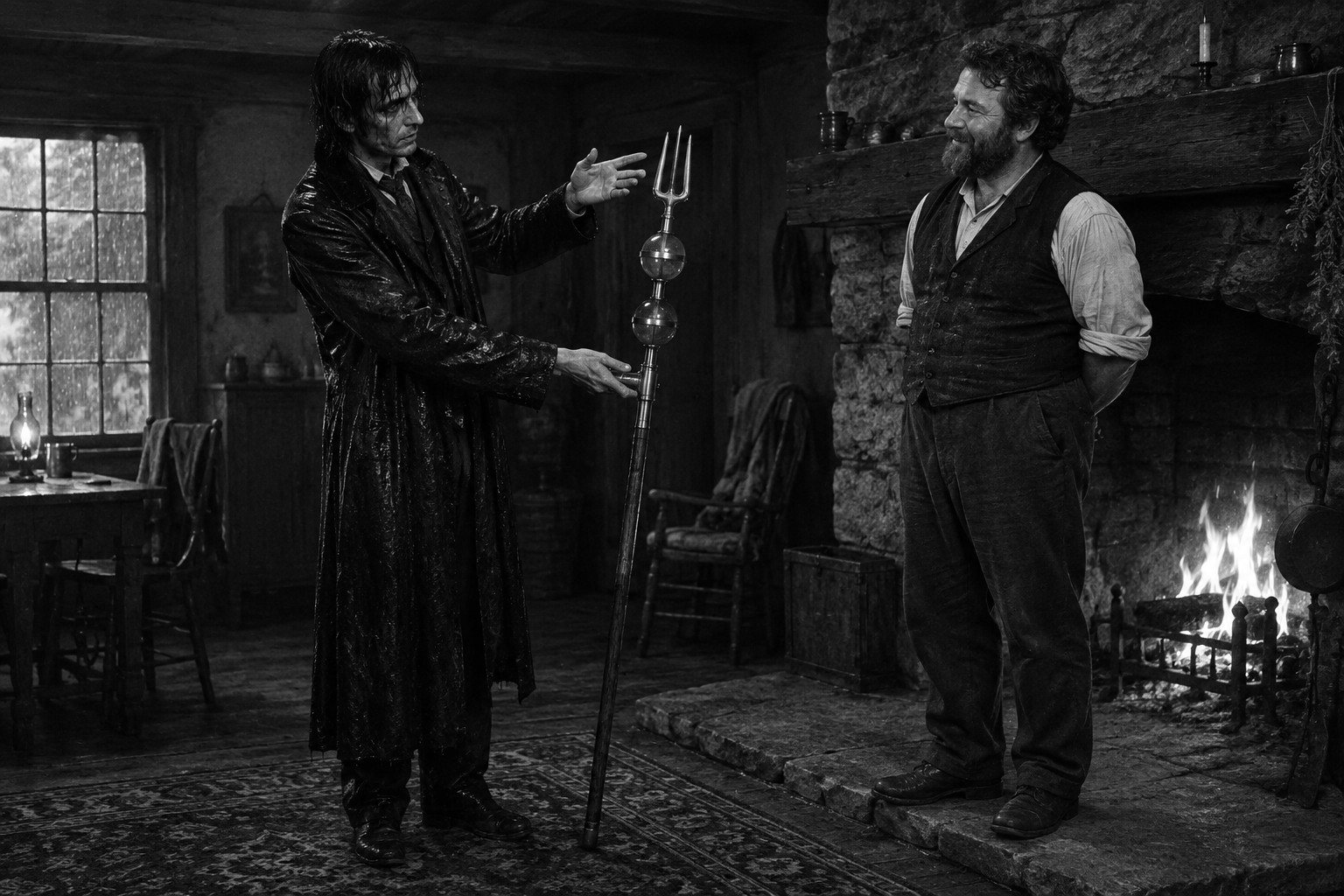
It was a polished copper rod, four feet long, lengthwise attached to a neat wooden staff, by insertion into two balls of greenish glass, ringed with copper bands. The metal rod terminated at the top tripodwise, in three keen tines, brightly gilt. He held the thing by the wooden part alone.
“Sir,” said I, bowing politely, “have I the honor of a visit from that illustrious god, Jupiter Tonans? So stood he in the Greek statue of old, grasping the lightning-bolt. If you be he, or his viceroy, I have to thank you for this noble storm you have brewed among our mountains. Listen: That was a glorious peal. Ah, to a lover of the majestic, it is a good thing to have the Thunderer himself in one’s cottage. The thunder grows finer for that. But pray be seated. This old rush-bottomed arm-chair, I grant, is a poor substitute for your evergreen throne on Olympus; but, condescend to be seated.”
While I thus pleasantly spoke, the stranger eyed me, half in wonder, and half in a strange sort of horror; but did not move a foot.
“Do, sir, be seated; you need to be dried ere going forth again.”
I planted the chair invitingly on the broad hearth, where a little fire had been kindled that afternoon to dissipate the dampness, not the cold; for it was early in the month of September.
But without heeding my solicitation, and still standing in the middle of the floor, the stranger gazed at me portentously and spoke.
“Sir,” said he, “excuse me; but instead of my accepting your invitation to be seated on the hearth there, I solemnly warn you, that you had best accept mine, and stand with me in the middle of the room. Good heavens!” he cried, starting—“there is another of those awful crashes. I warn you, sir, quit the hearth.”
“Mr. Jupiter Tonans,” said I, quietly rolling my body on the stone, “I stand very well here.”
“Are you so horridly ignorant, then,” he cried, “as not to know, that by far the most dangerous part of a house, during such a terrific tempest as this, is the fire-place?”
“Nay, I did not know that,” involuntarily stepping upon the first board next to the stone.
The stranger now assumed such an unpleasant air of successful admonition, that—quite involuntarily again—I stepped back upon the hearth, and threw myself into the erectest, proudest posture I could command. But I said nothing.
“For Heaven’s sake,” he cried, with a strange mixture of alarm and intimidation—“for Heaven’s sake, get off the hearth! Know you not, that the heated air and soot are conductors;—to say nothing of those immense iron fire-dogs? Quit the spot—I conjure—I command you.”
“Mr. Jupiter Tonans, I am not accustomed to be commanded in my own house.”
“Call me not by that pagan name. You are profane in this time of terror.”
“Sir, will you be so good as to tell me your business? If you seek shelter from the storm, you are welcome, so long as you be civil; but if you come on business, open it forthwith. Who are you?”
“I am a dealer in lightning-rods,” said the stranger, softening his tone; “my special business is—Merciful heaven! what a crash!—Have you ever been struck—your premises, I mean? No? It’s best to be provided;”—significantly rattling his metallic staff on the floor;—“by nature, there are no castles in thunder-storms; yet, say but the word, and of this cottage I can make a Gibraltar by a few waves of this wand. Hark, what Himalayas of concussions!”
“You interrupted yourself; your special business you were about to speak of.”
“My special business is to travel the country for orders for lightning-rods. This is my specimen-rod;” tapping his staff; “I have the best of references”—fumbling in his pockets. “In Criggan last month, I put up three-and-twenty rods on only five buildings.”
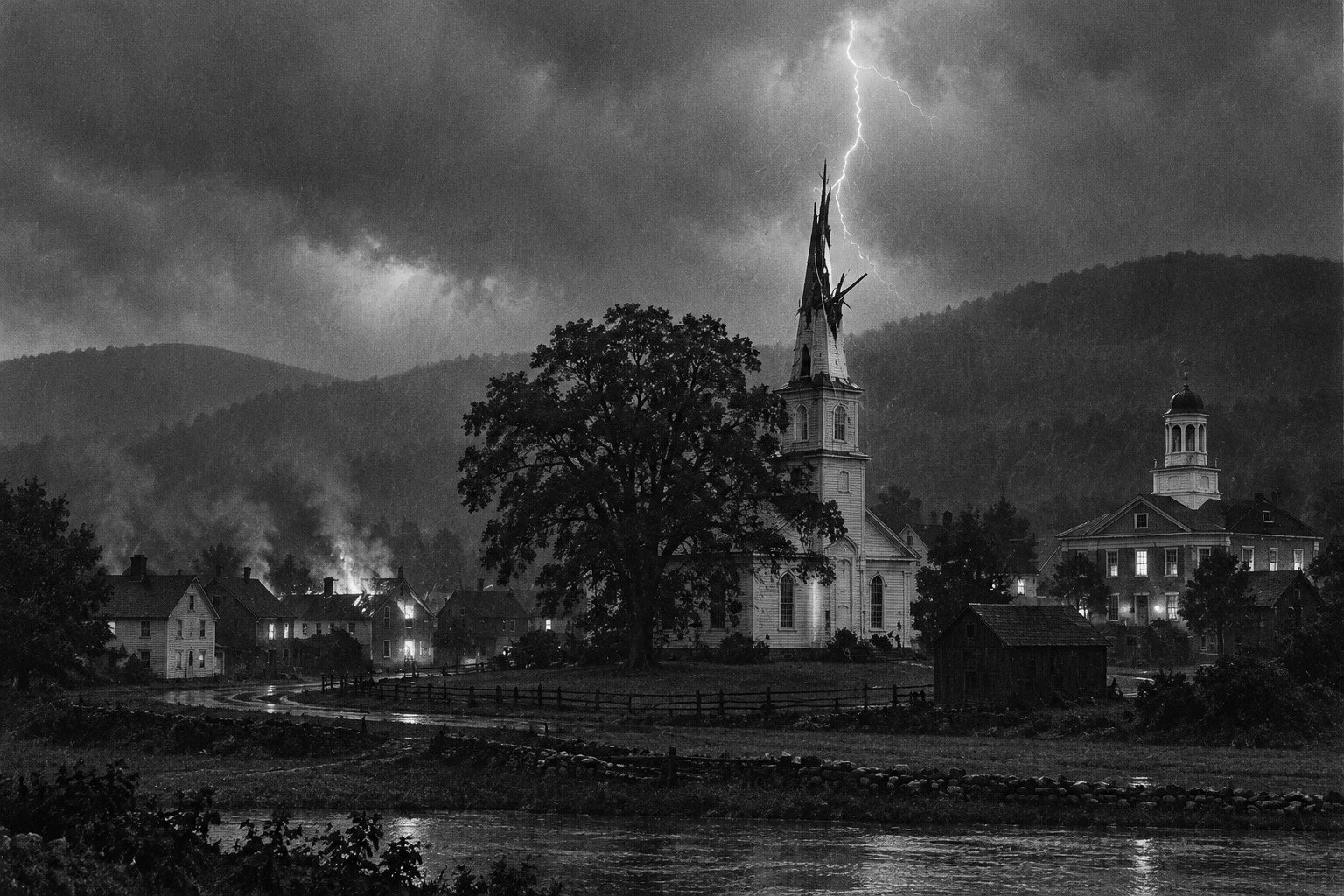
“Let me see. Was it not at Criggan last week, about midnight on Saturday, that the steeple, the big elm, and the assembly-room cupola were struck? Any of your rods there?”
“Not on the tree and cupola, but the steeple.”
“Of what use is your rod, then?”
“Of life-and-death use. But my workman was heedless. In fitting the rod at top to the steeple, he allowed a part of the metal to graze the tin sheeting. Hence the accident. Not my fault, but his. Hark!”
“Never mind. That clap burst quite loud enough to be heard without finger-pointing. Did you hear of the event at Montreal last year? A servant girl struck at her bed-side with a rosary in her hand; the beads being metal. Does your beat extend into the Canadas?”
“No. And I hear that there, iron rods only are in use. They should have mine, which are copper. Iron is easily fused. Then they draw out the rod so slender, that it has not body enough to conduct the full electric current. The metal melts; the building is destroyed. My copper rods never act so. Those Canadians are fools. Some of them knob the rod at the top, which risks a deadly explosion, instead of imperceptibly carrying down the current into the earth, as this sort of rod does. Mine is the only true rod. Look at it. Only one dollar a foot.”
“This abuse of your own calling in another might make one distrustful with respect to yourself.”
“Hark! The thunder becomes less muttering. It is nearing us, and nearing the earth, too. Hark! One crammed crash! All the vibrations made one by nearness. Another flash. Hold!”
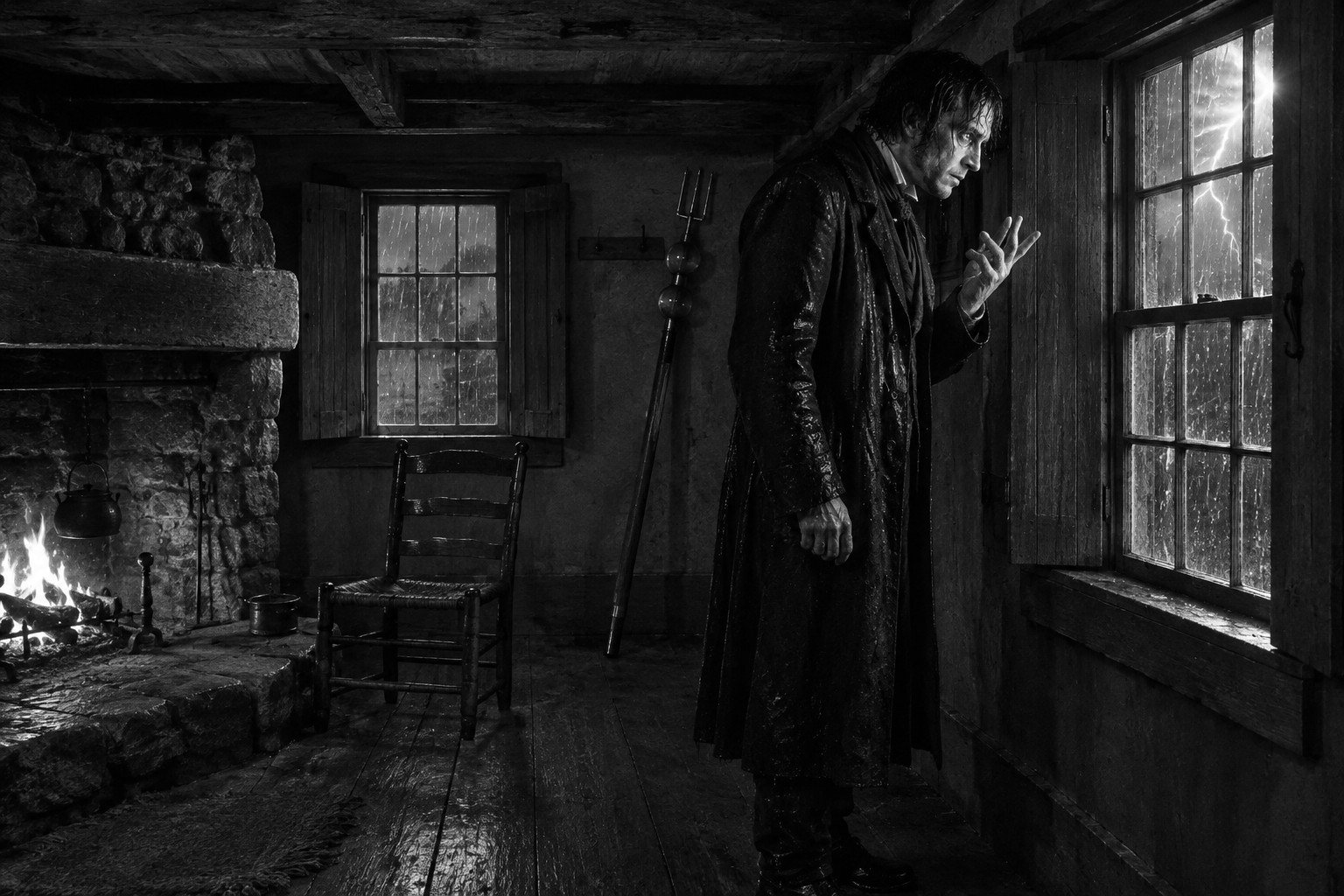
“What do you?” I said, seeing him now, instantaneously relinquishing his staff, lean intently forward towards the window, with his right fore and middle fingers on his left wrist. But ere the words had well escaped me, another exclamation escaped him.
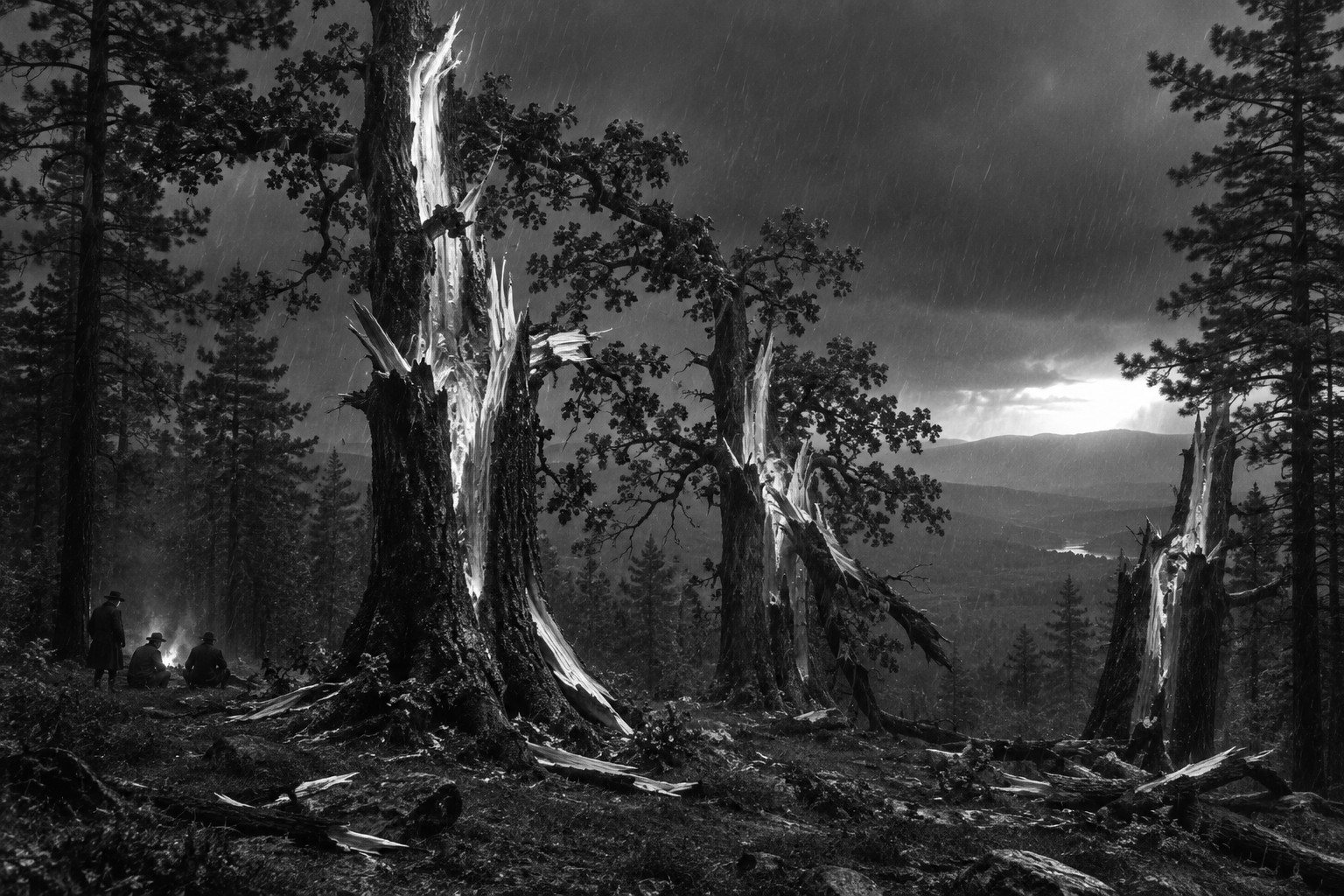
“Crash! only three pulses—less than a third of a mile off—yonder, somewhere in that wood. I passed three stricken oaks there, ripped out new and glittering. The oak draws lightning more than other timber, having iron in solution in its sap. Your floor here seems oak.
“Heart-of-oak. From the peculiar time of your call upon me, I suppose you purposely select stormy weather for your journeys. When the thunder is roaring, you deem it an hour peculiarly favorable for producing impressions favorable to your trade.”
“Hark!—Awful!”
“For one who would arm others with fear you seem unbeseemingly timorous yourself. Common men choose fair weather for their travels: you choose thunder-storms; and yet—”
“That I travel in thunder-storms, I grant; but not without particular precautions, such as only a lightning-rod man may know. Hark! Quick—look at my specimen rod. Only one dollar a foot.”
“A very fine rod, I dare say. But what are these particular precautions of yours? Yet first let me close yonder shutters; the slanting rain is beating through the sash. I will bar up.”
“Are you mad? Know you not that yon iron bar is a swift conductor? Desist.”
“I will simply close the shutters, then, and call my boy to bring me a wooden bar. Pray, touch the bell-pull there.
“Are you frantic? That bell-wire might blast you. Never touch bell-wire in a thunder-storm, nor ring a bell of any sort.”
“Nor those in belfries? Pray, will you tell me where and how one may be safe in a time like this? Is there any part of my house I may touch with hopes of my life?”
“There is; but not where you now stand. Come away from the wall. The current will sometimes run down a wall, and—a man being a better conductor than a wall—it would leave the wall and run into him. Swoop! That must have fallen very nigh. That must have been globular lightning.”
“Very probably. Tell me at once, which is, in your opinion, the safest part of this house?
“This room, and this one spot in it where I stand. Come hither.”
“The reasons first.”
“Hark!—after the flash the gust—the sashes shiver—the house, the house!—Come hither to me!”
“The reasons, if you please.”
“Come hither to me!”
“Thank you again, I think I will try my old stand—the hearth. And now, Mr. Lightning-rod-man, in the pauses of the thunder, be so good as to tell me your reasons for esteeming this one room of the house the safest, and your own one stand-point there the safest spot in it.”
There was now a little cessation of the storm for a while. The Lightning-rod man seemed relieved, and replied:—
“Your house is a one-storied house, with an attic and a cellar; this room is between. Hence its comparative safety. Because lightning sometimes passes from the clouds to the earth, and sometimes from the earth to the clouds. Do you comprehend?—and I choose the middle of the room, because if the lightning should strike the house at all, it would come down the chimney or walls; so, obviously, the further you are from them, the better. Come hither to me, now.”
“Presently. Something you just said, instead of alarming me, has strangely inspired confidence.”
“What have I said?”
“You said that sometimes lightning flashes from the earth to the clouds.”
“Aye, the returning-stroke, as it is called; when the earth, being overcharged with the fluid, flashes its surplus upward.”
“The returning-stroke; that is, from earth to sky. Better and better. But come here on the hearth and dry yourself.”
“I am better here, and better wet.”
“How?”
“It is the safest thing you can do—Hark, again!—to get yourself thoroughly drenched in a thunder-storm. Wet clothes are better conductors than the body; and so, if the lightning strike, it might pass down the wet clothes without touching the body. The storm deepens again. Have you a rug in the house? Rugs are non-conductors. Get one, that I may stand on it here, and you, too. The skies blacken—it is dusk at noon. Hark!—the rug, the rug!”
I gave him one; while the hooded mountains seemed closing and tumbling into the cottage.
“And now, since our being dumb will not help us,” said I, resuming my place, “let me hear your precautions in traveling during thunder-storms.”
“Wait till this one is passed.”
“Nay, proceed with the precautions. You stand in the safest possible place according to your own account. Go on.”
“Briefly, then. I avoid pine-trees, high houses, lonely barns, upland pastures, running water, flocks of cattle and sheep, a crowd of men. If I travel on foot—as to-day—I do not walk fast; if in my buggy, I touch not its back or sides; if on horseback, I dismount and lead the horse. But of all things, I avoid tall men.”
“Do I dream? Man avoid man? and in danger-time, too.”
“Tall men in a thunder-storm I avoid. Are you so grossly ignorant as not to know, that the height of a six-footer is sufficient to discharge an electric cloud upon him? Are not lonely Kentuckians, ploughing, smit in the unfinished furrow? Nay, if the six-footer stand by running water, the cloud will sometimes select him as its conductor to that running water. Hark! Sure, yon black pinnacle is split. Yes, a man is a good conductor. The lightning goes through and through a man, but only peels a tree. But sir, you have kept me so long answering your questions, that I have not yet come to business. Will you order one of my rods? Look at this specimen one? See: it is of the best of copper. Copper’s the best conductor. Your house is low; but being upon the mountains, that lowness does not one whit depress it. You mountaineers are most exposed. In mountainous countries the lightning-rod man should have most business. Look at the specimen, sir. One rod will answer for a house so small as this. Look over these recommendations. Only one rod, sir; cost, only twenty dollars. Hark! There go all the granite Taconics and Hoosics dashed together like pebbles. By the sound, that must have struck something. An elevation of five feet above the house, will protect twenty feet radius all about the rod. Only twenty dollars, sir—a dollar a foot. Hark!—Dreadful!—Will you order? Will you buy? Shall I put down your name? Think of being a heap of charred offal, like a haltered horse burnt in his stall; and all in one flash!”
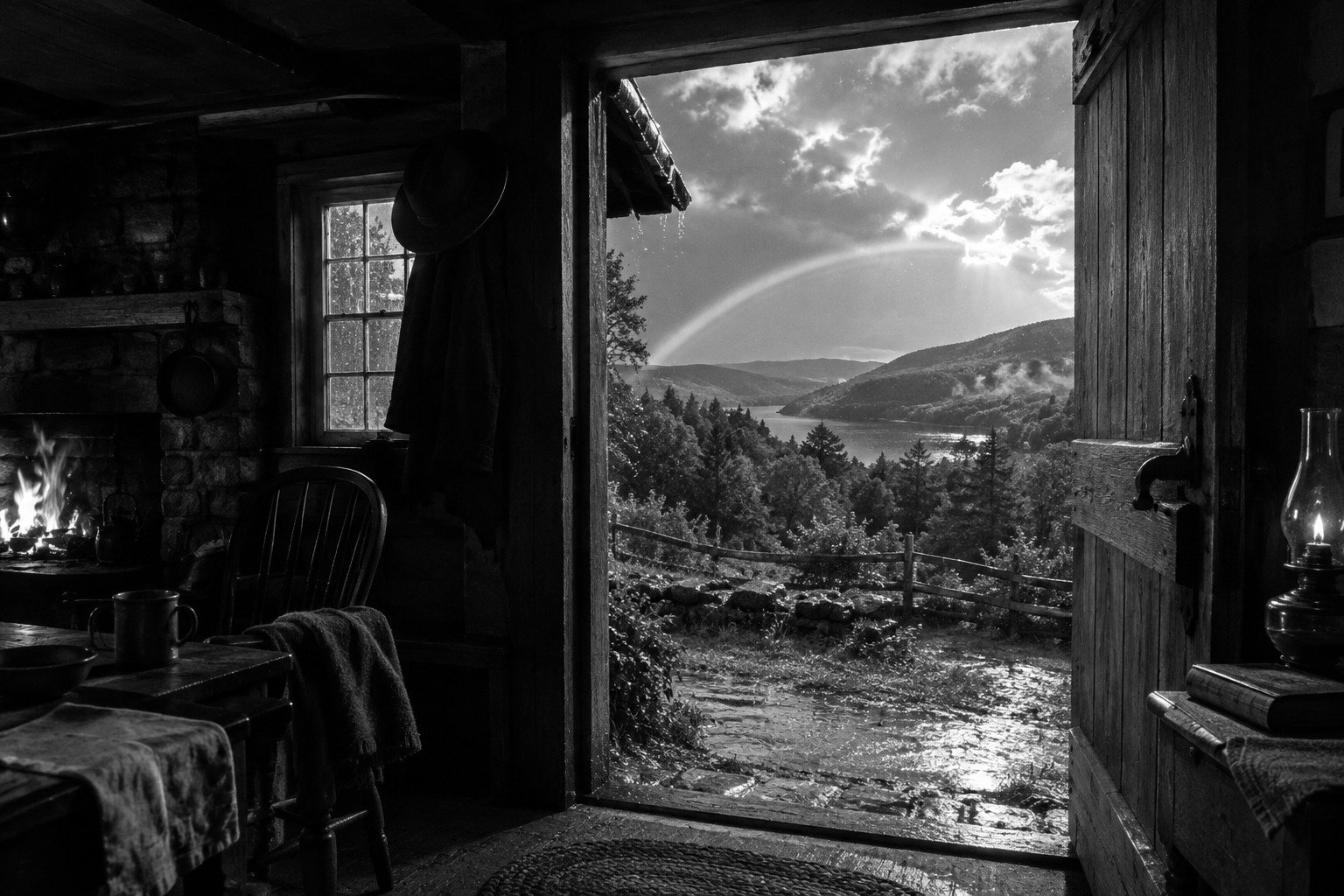
“You pretended envoy extraordinary and minister plenipotentiary to and from Jupiter Tonans,” laughed I; “you mere man who come here to put you and your pipestem between clay and sky, do you think that because you can strike a bit of green light from the Leyden jar, that you can thoroughly avert the supernal bolt? Your rod rusts, or breaks, and where are you? Who has empowered you, you Tetzel, to peddle round your indulgences from divine ordinations? The hairs of our heads are numbered, and the days of our lives. In thunder as in sunshine, I stand at ease in the hands of my God. False negotiator, away! See, the scroll of the storm is rolled back; the house is unharmed; and in the blue heavens I read in the rainbow, that the Deity will not, of purpose, make war on man’s earth.”
“Impious wretch!” foamed the stranger, blackening in the face as the rainbow beamed, “I will publish your infidel notions.”
The scowl grew blacker on his face; the indigo-circles enlarged round his eyes as the storm-rings round the midnight moon. He sprang upon me; his tri-forked thing at my heart.
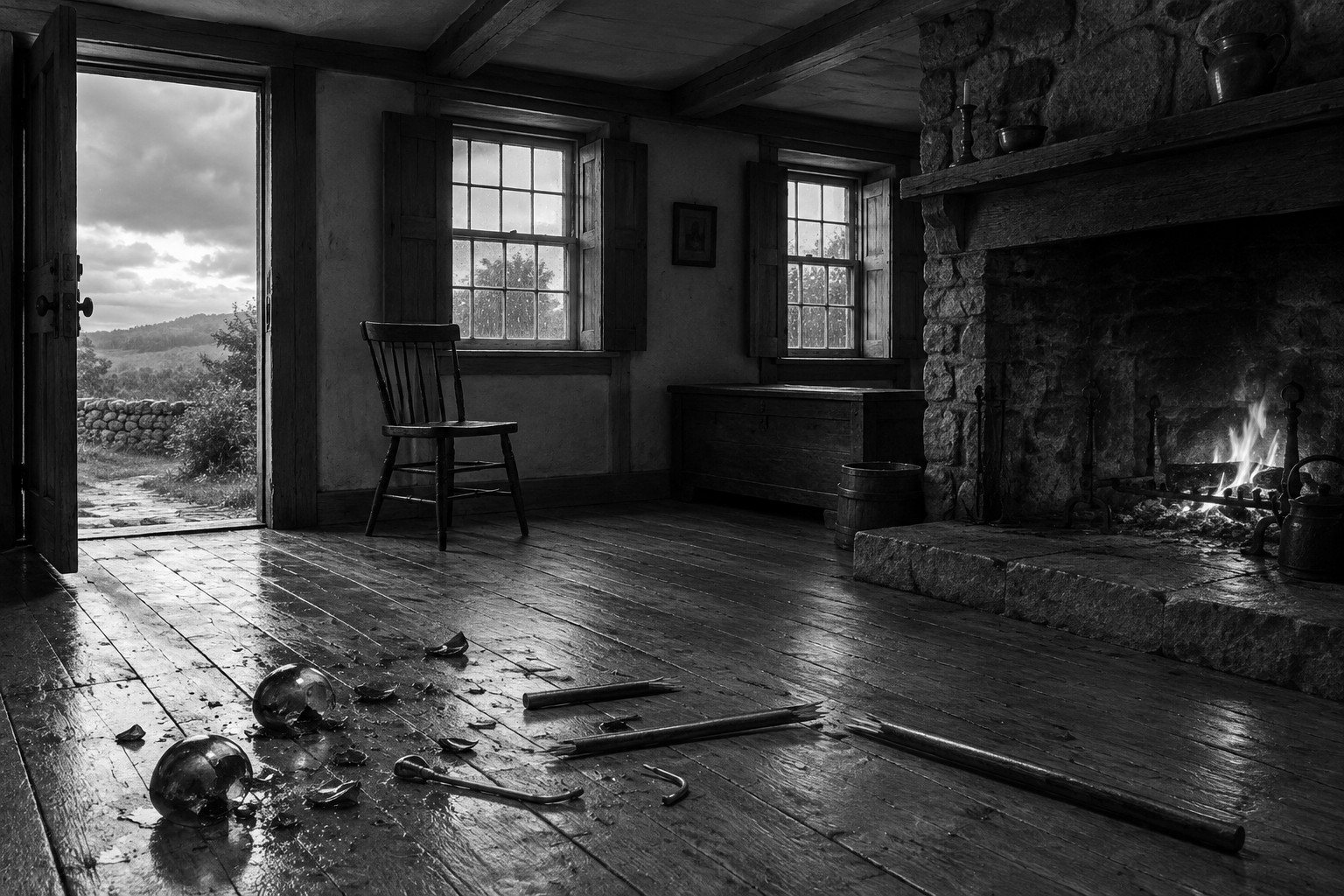
I seized it; I snapped it; I dashed it; I trod it; and dragging the dark lightning-king out of my door, flung his elbowed, copper sceptre after him.
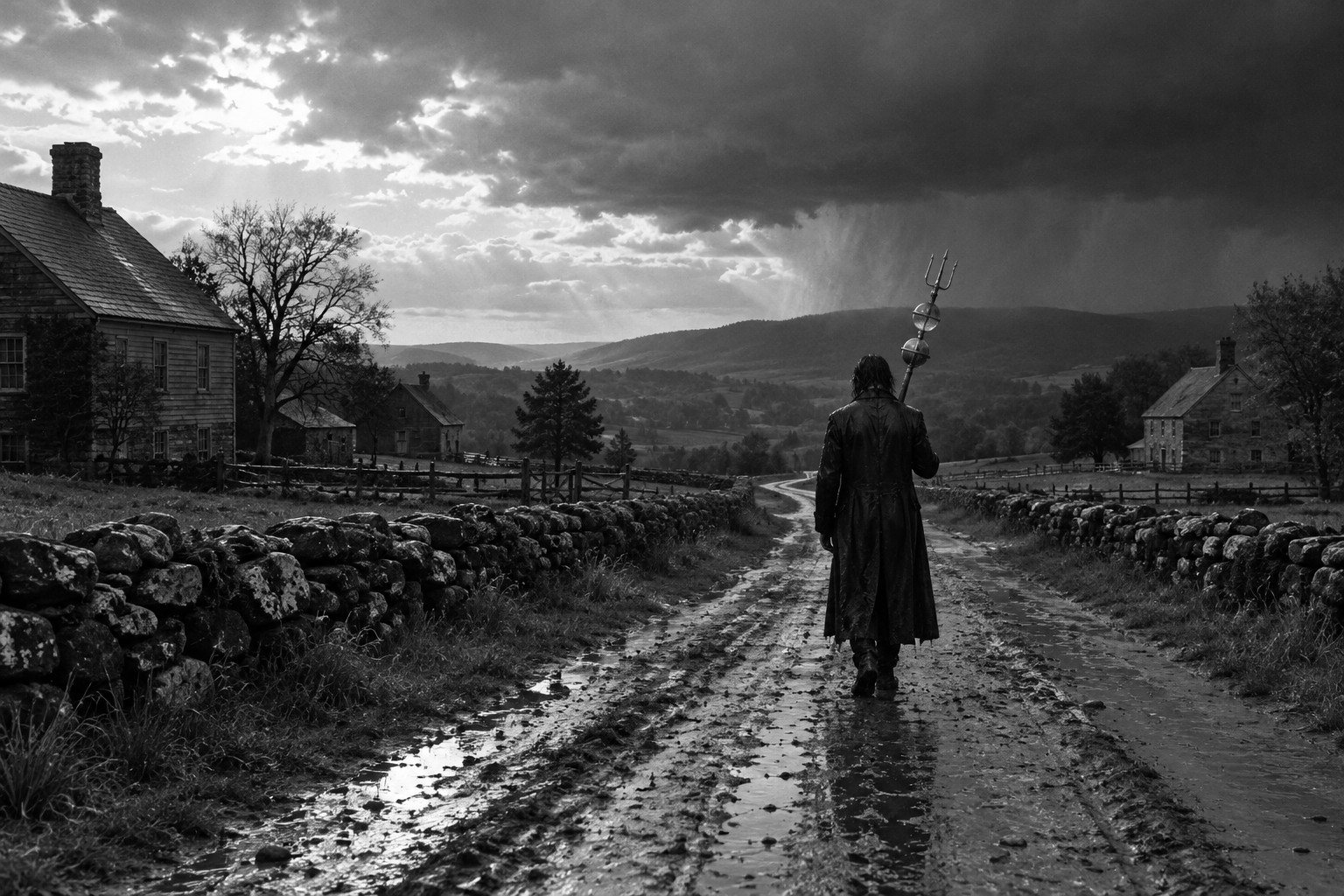
But spite of my treatment, and spite of my dissuasive talk of him to my neighbors, the Lightning-rod man still dwells in the land; still travels in storm-time, and drives a brave trade with the fears of man.